1. What is Python?
-Python is a high-level interpreted programming language. It is used for web development, data science, AI, automation, and more.
2. What does a “library” in Python mean?
-A library in python is a collection of pre-written code that provides functions and modules to help preform specific tasks, such as machine learning.
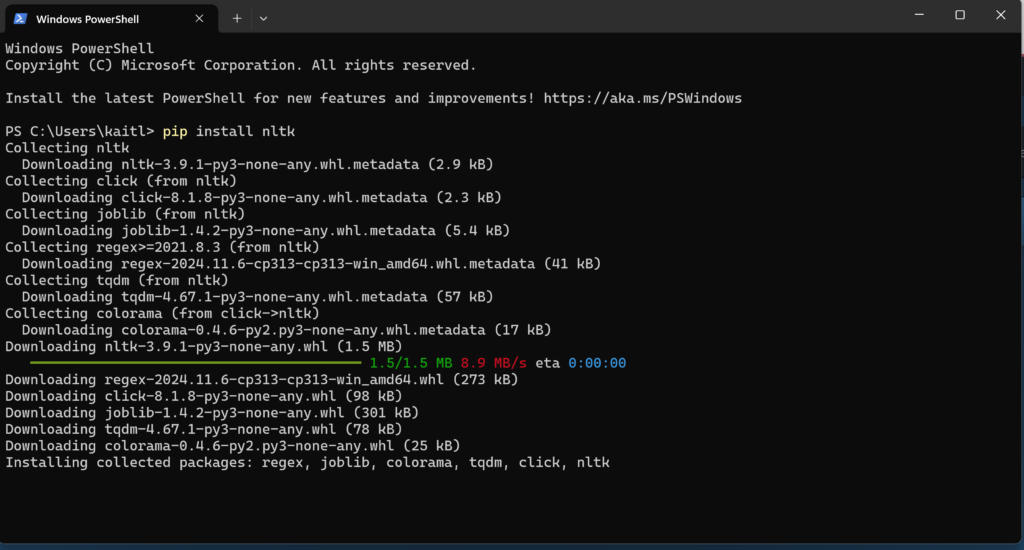
3. Attach a screenshot to show you installed NLTK.
- The CALL tool that I tried out was DuoLingo.
- Duolingo gives instant feedback after each question. When you get an answer right, it rewards you with sounds, a green checkmark. If you get it wrong, it shows the correct answer and sometimes gives a short explanation or review option. The app adjusts to your mistakes and strengths, making the learning experience somewhat personalized. This helps learners improve based on their performance.
- Duolingo often uses fill-in-the-blank questions to test language skills. Some of these questions accept multiple correct answers, especially when translations have flexible meanings. However, some answers are strict, and small differences, even if grammatically correct, may be marked wrong. This can sometimes make learning frustrating for users.
Duolingo helps users learn through immersion by using context-based lessons, audio, speaking practice, and stories. It encourages working through the language by having users translate, listen, and speak in real-time. However, the app follows a strict lesson structure, so there is little flexibility for alternative learning methods. This means users must follow the set path rather than explore different ways to learn.
Which search engine is the best?
I chose to compare DuckDuckGo and Google
Google Results for “Washington”
- The first page includes results about Washington, D.C., Washington state, George Washington, and the Washington Post.
- The search engine seems to cluster these topics by relevance based on my location and search history (if applicable).
DuckDuckGo Results for “Washington”
- The first page shows a mix of results about Washington state, Washington, D.C., and some history about George Washington.
- Since DuckDuckGo does not personalize searches, results are more neutral and less influenced by past search behavior.
Google was the better search engine in my opinion because it provides better clustering and context-aware results, making it easier to find relevant information. However, DuckDuckGo offers more neutral, privacy-focused results.
I will search for “Mars rover latest updates” on both engines.
Google Results
- The first 20 results mostly come from NASA, major news outlets (CNN, BBC, The Verge), and scientific sources.
- Many links are up-to-date and include featured snippets with direct answers.
DuckDuckGo Results
- Results are similar but with slightly less ranking priority given to major news sources.
- Fewer featured snippets, and results seem more varied rather than emphasizing official sources.
I felt that Google was still the better option for me because it provides better precision by ranking authoritative sources higher.
Recall refers to how well a search engine retrieves all relevant results. Measuring recall is difficult because it requires knowing all possible relevant documents on the internet.
- Google’s recall may be better since it indexes the most web pages and uses advanced ranking algorithms.
- DuckDuckGo may have slightly lower recall since it relies on Bing’s search index and does not personalize searches.
Conclusion: It is difficult to definitively determine recall because we cannot see all potentially relevant results that exist. However, Google likely has higher recall due to its larger index and advanced algorithms.
Corpus Linguistics
As I was searching through these two restaurants I noticed that there were more searches for Chipotle and the frequency was higher for Chipotle. It is newer and is expanding more than Pizza Hut is. I searched using Google and the COCA website which showed the frequencies. A number of people have started to like Chipotle more because there are many options there and it is way healthier for people and there are many people who decide the healthier options.
We developed an AI-powered facial emotion recognition app to monitor the emotional well-being of elderly nursing home residents. The model detects whether a resident appears happy or sad and sends alerts to loved ones if sadness is detected too frequently. This proof of concept demonstrates how machine learning can enhance emotional care and mental health monitoring.
How We Trained the Model
Using Teachable Machine, we trained the model with:
- Happy Faces: Elderly individuals smiling, laughing, or appearing engaged in conversations.
- Sad Faces: Elderly individuals frowning, looking down, or appearing withdrawn.
Challenges & Additional Data Needs
- Data Limitations:
- Our dataset was limited to publicly available images and did not include diverse ethnicities, facial expressions, or real-life nursing home settings.
- Collecting real-world video clips from nursing homes would improve accuracy.
- Complex Emotions:
- The model may struggle with neutral faces or subtle emotions like loneliness.
- Adding contextual cues (e.g., speech tone, body language) would enhance detection.
- Ethical Considerations:
- Privacy and consent are critical when using AI for facial recognition in healthcare.
Model Performance & Future Improvements
- Works Well: Differentiating between clear happy and sad expressions in well-lit images.
- Fails When:
- Poor lighting or partial facial visibility affects accuracy.
- A resident’s sadness is expressed in ways not captured in the dataset (e.g., silent withdrawal rather than facial expressions).
- Future Enhancements:
- Multimodal AI that combines facial recognition with voice analysis.
- Customizable alerts for caregivers based on residents’ individual emotional baselines.

Part 1: The product that I chose was “Bombas”. Which is a company that has appeared on Shark Tank and is sold on Amazon and has its own official website. A chatbot can improve Bombas’ customer interaction and sales by offering instant support for product questions, providing personalized sock recommendations, and promoting discounts or bundle deals. It can also assist with setting up subscription services, engage customers by highlighting the company’s charitable initiatives, and provide order updates to reduce inquiries. These features enhance the shopping experience, increase conversions, and foster customer loyalty.
Part 2: For this project, I would choose Tars as the no-code chatbot tool. Tars is a versatile platform that allows for easy creation of chatbots for websites, making it ideal for Bombas to integrate directly with their e-commerce site. The platform’s drag-and-drop interface is simple to use, enabling the creation of customized chat flows without any coding knowledge. Tars also supports lead generation, product recommendations, and order assistance, which makes it a perfect fit for enhancing the customer journey on Bombas’ website. Additionally, its flexibility in integrating with websites and its ability to provide a seamless user experience make it well-suited for driving conversions and boosting sales.
Part 3: Screen shot is at the top. The Tars-powered chatbot can enhance Bombas’ sales strategy by providing instant customer support, personalized product recommendations, and streamlined purchasing processes. It can increase conversion rates by offering tailored discounts, reduce cart abandonment, and encourage subscriptions for regular sock deliveries. Additionally, it strengthens customer loyalty by promoting Bombas’ social responsibility mission and providing 24/7 support. The chatbot also offers valuable insights into customer behavior, allowing Bombas to optimize sales and marketing strategies.
Part 4: Designing the chatbot for Bombas highlighted the value of automation in enhancing customer experience and driving sales. By offering personalized recommendations, instant support, and promoting promotions and subscriptions, the chatbot can reduce friction and increase conversion rates. It also strengthens customer engagement by fostering trust and satisfaction, especially through Bombas’ social responsibility mission. Ultimately, the chatbot can boost both immediate sales and long-term loyalty, making it a powerful tool for improving the overall shopping experience and sales strategy.
You work for a multinational company that has internet content that will be read with Google Translate by speakers from a variety of language backgrounds. The content creation team needs guidance of machine translation friendly texts. Create a two minute (or less) video giving them specific tips.
- Research: Begin by reviewing the “Garbage in, garbage out” principle as outlined in the resource provided here. Understand the importance of clear and straightforward writing to improve machine translation outcomes.
- Content Creation: Highlight key strategies for writing effectively for machine translation. Include tips on avoiding idioms, using simple sentence structures, and choosing clear, unambiguous words.
- Script and Storyboard: Write a concise script that conveys your message engagingly and effectively. Create a storyboard to plan the visuals accompanying your script.
- Production: Utilize any video editing software available to you. Ensure your video is clear, visually appealing, and includes examples to illustrate your points. Use of AI is encouraged.
- Reference: Clearly reference the “Garbage in, Garbage out” principles and how it underscores the necessity of quality input for quality output in machine translations.
- Submission: Upload your final video to YouTube ad your website.
Leafville High School AI Use Policy
I. Introduction
Purpose of the Policy: The integration of generative AI into education presents both opportunities and challenges. AI tools can support learning by fostering creativity, improving efficiency, and providing personalized feedback. However, concerns regarding academic integrity, bias, and privacy necessitate a structured approach. This policy ensures that AI is used ethically, responsibly, and equitably within Leafville High School.
Scope: This policy applies to all students, teachers, and administrative staff at Leafville High School. It governs the use of AI tools in classrooms, homework, research projects, and any school-related activities where AI is utilized.
II. Definitions
Generative AI: Refers to AI systems capable of creating text, images, or other content based on prompts, including but not limited to ChatGPT, DALL·E, and AI-powered writing assistants.
Key Terms:
Academic Integrity: Commitment to honest and original work.
Bias: The presence of unfair or prejudiced outputs in AI-generated content.
Privacy: Protection of personal and educational data from unauthorized access.
III. Ethical Principles
Integrity and Honesty: Students must disclose AI assistance in their work and avoid using AI tools to misrepresent their abilities or efforts.
Equity and Accessibility: AI tools should be made available equitably to all students, ensuring that those without personal access are not disadvantaged.
Privacy and Security: All use of AI must comply with the Family Educational Rights and Privacy Act (FERPA). No student data should be input into AI systems without proper consent and safeguards.
IV. Guidelines for Use
Educational Use Cases:
AI tools may assist in brainstorming, tutoring, language translation, and research synthesis.
Teachers may incorporate AI to enhance lesson planning and grading efficiency.
Prohibited Uses:
Submitting AI-generated content as entirely original work.
Using AI to complete assessments without teacher approval.
Entering sensitive or personally identifiable information into AI systems.
Collaboration and Sharing:
AI-assisted work must be properly cited.
Students should engage in discussions about AI-generated content to develop critical thinking skills.
V. Responsibilities
Students:
Use AI ethically and with teacher guidance.
Cite AI-generated contributions.
Teachers and Staff:
Provide guidance on responsible AI use.
Monitor AI-assisted work for ethical concerns.
Administration:
Ensure access to AI resources and training.
Maintain compliance with FERPA and other relevant regulations.
VI. Monitoring and Compliance
Monitoring Use: Teachers and administrators may review AI-generated submissions for compliance with academic integrity standards.
Handling Violations: Violations of this policy may result in academic consequences, with opportunities for education on proper AI use.
VII. Support and Resources
Training and Education:
Workshops for teachers and students on AI literacy.
Integration of AI ethics discussions into curriculum.
Technical Support:
Limited on-site technical assistance.
Online resources and external partnerships for AI education.
VIII. Review and Update
Policy Review Schedule: Reviewed annually by a committee of educators, students, and parents.
Feedback Mechanism: Open forums, surveys, and meetings to gather input from stakeholders on AI policy effectiveness and needed changes.